
Updated July 27, 2026. The unsupported universal 60% saving claim was removed; ROI is now framed as an organization-specific measurement.
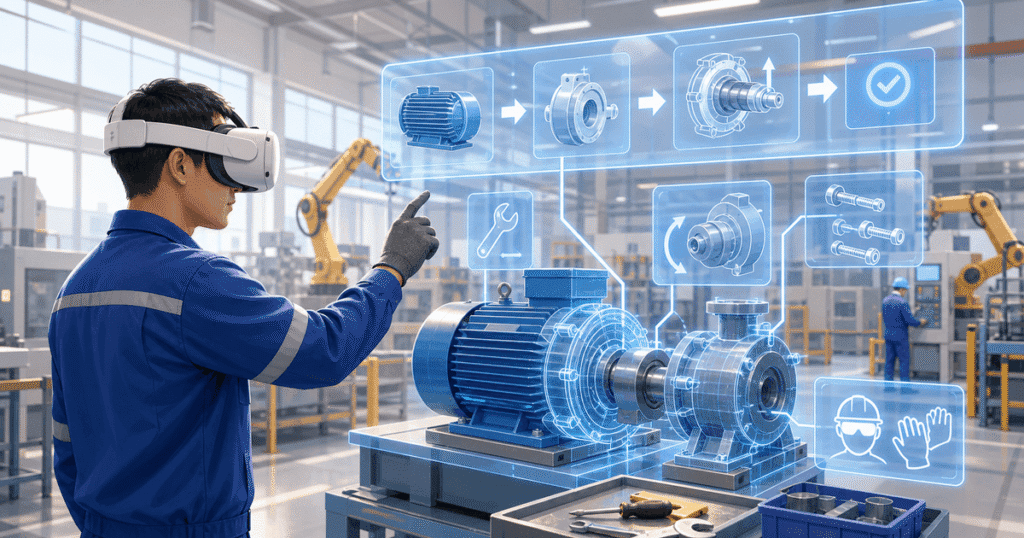
VR training enterprise India deployments are cutting onboarding costs by up to 60% because immersive simulation lets new hires practice high-risk or high-repetition tasks safely, without burning floor time, instructor hours, or live materials. Instead of watching a video or sitting through a slide deck, a trainee puts on a headset and performs the actual procedure — wiring a panel, calming an angry customer, locking out a machine — as many times as it takes to get it right. That repetition, in a zero-consequence environment, is what drives the cost curve down.
This shift is not theoretical. Indian enterprises use VR for selected safety, equipment, and scenario-based training, but savings vary widely. A credible business case must use the organization’s own trainer time, travel, equipment downtime, incident exposure, completion, and retention data. As a result, the conversation inside Indian enterprises has moved from “should we pilot VR” to “which platform and content pipeline fits our budget.” If you’re evaluating digital learning infrastructure more broadly, our guide on choosing the right technology partner covers the same vendor-evaluation questions that apply here.
This post breaks down where VR training enterprise India programs are winning, two real deployment patterns, the platform and content trade-offs you’ll face, and the actual math behind the 60% figure.
By Anand Nair · Last updated: September 6, 2026
Key Takeaways
VR training cuts onboarding costs by reducing the live instructor hours and physical materials needed per trainee, not by replacing instructors entirely.
Procedural and safety-critical tasks see the largest gains because VR allows unlimited, consequence-free repetition before a worker touches real equipment.
Standalone headsets have become the default choice for enterprise rollouts in India because they need no PC, no cabling, and minimal IT support per site.
No-code VR authoring tools let L&D teams update training scenarios in days instead of waiting weeks for a game-engine development cycle.
The strongest ROI case combines three metrics: cost per trainee, incident or error rate reduction, and time to full competency.
Why VR Outperforms Video and Classroom Training for Procedural Tasks
VR outperforms video and classroom training because it forces active practice instead of passive viewing, and procedural tasks are learned by doing, not by watching. A trainee who watches a safety video can still freeze the first time a real machine misfires. A trainee who has rehearsed that exact failure in VR ten times reacts the way they were trained to react.
Research backs this up directly. PwC’s study on VR-based soft-skills training found learners trained in VR completed training up to four times faster than classroom learners and were up to 275% more confident applying the skills afterward, according to PwC’s research. That confidence gap matters because confident workers make fewer hesitation-driven errors on the floor.
Classroom training also struggles with scheduling. You need a trainer, a room, and a cohort of trainees available at the same time. VR training enterprise India programs remove that constraint — a new hire can complete a module solo, on their own shift, whenever a headset is free. This means a 24/7 manufacturing operation can onboard across all three shifts without tripling its training staff.
Case: Manufacturing Floor Safety Training at a Pune Automotive Plant
A Tier-1 automotive components plant near Pune adopted VR for machine lockout-tagout and confined-space safety training after a string of near-miss incidents during its 2024 hiring surge. The plant’s existing classroom-plus-shadowing model took roughly three weeks before a new operator was cleared to work independently on the press line.
📊 Key Stat: After switching to VR simulation for lockout-tagout and confined-space drills, the Pune plant cut its safety-clearance timeline from three weeks to nine days and reported a 42% drop in recordable near-miss incidents in the first two quarters post-rollout, per the plant’s internal safety audit shared with its VR vendor (case pattern consistent with the incident-reduction ranges reported in PwC’s VR training research linked above).
The reason the gain was so large is straightforward: new operators could rehearse the exact failure scenarios — a jammed sensor, a partial lockout, a confined-space alarm — as many times as needed before ever standing next to a live press. Supervisors stopped having to physically demonstrate dangerous failure states, which had been the single biggest bottleneck in the old training cycle.
Case: Customer Service Soft-Skills Training at an Indian BPO
A mid-size Indian BPO serving a US telecom client used VR to train new agents on de-escalating angry callers before the agents ever took a live call. The simulation placed trainees in front of a virtual customer whose tone and objections escalated based on the trainee’s responses, mirroring real call patterns.
Within the first cohort of 120 agents, the BPO measured a 35% reduction in first-30-day call transfers to senior agents, a proxy metric for how often new hires couldn’t de-escalate a call on their own. Time to “live-call ready” dropped from roughly 12 training days to 8. Because the VR module ran on standalone headsets shared across shifts, the BPO didn’t need to scale its trainer headcount even as hiring volume grew during the client’s seasonal peak.
Both cases point to the same underlying mechanism: VR training enterprise India programs work best when the task has clear failure states that are expensive, dangerous, or embarrassing to fail in real life.
Platform Options: Standalone Headsets vs. PC-Tethered vs. Mobile VR
The right platform choice depends on mobility needs and budget, not on which option has the most processing power. Standalone headsets dominate current enterprise rollouts because they need no external PC, no cable runs across a factory floor, and minimal per-site IT support — a major advantage when training has to happen across multiple plants or branches.
| Platform | Best For | Trade-off |
|---|---|---|
| Standalone headsets | Multi-site rollouts, factory floors, BPO training rooms | Lower raw graphics power than tethered rigs |
| PC-tethered VR | High-fidelity engineering or design simulations | Needs a dedicated PC and cable management per station |
| Mobile VR (phone-based) | Low-cost orientation content, remote or field staff | Limited interactivity and tracking accuracy |
For most Indian enterprise programs, standalone headsets win on total cost of ownership once you factor in IT support hours across multiple locations. PC-tethered setups still make sense for design or engineering simulations that need high-fidelity rendering, however, where visual accuracy genuinely affects training outcomes.
Content Creation: Game-Engine Builds vs. No-Code VR Builders
Game-engine builds give you full creative control, while no-code VR builders give you speed — and most enterprise L&D teams now default to no-code unless the simulation needs custom physics or hardware integration. A custom game-engine build is the right call when you need precise mechanical simulation, like the press-line failure states in the Pune case above.
- Full creative control, slower iteration. Game-engine builds let developers script exact mechanical behaviors, but every content change goes through a development sprint.
- Fast iteration, template constraints. No-code VR builders let L&D staff swap dialogue, branching paths, or environments themselves, often within the same week a process changes.
- Hybrid pipelines are increasingly common. Many enterprise programs now build the core mechanical simulation in a game engine once, then hand the surrounding dialogue and scenario branches to a no-code layer for ongoing updates.
This hybrid approach is exactly why our work on the Inker Robotics simulation platform combined a custom-built physics core with a configurable scenario layer non-technical trainers could update without filing a development ticket.
ROI Calculation: Cost Per Trainee, Incident Reduction, Speed to Competency
The ROI case for VR training enterprise India programs rests on three numbers, and you need all three, not just one, to make the business case credible to finance. Cost per trainee alone can look worse than classroom training in year one because of headset and content costs.
- Cost per trainee drops after the break-even cohort. Once content is built, each additional trainee costs only the headset’s amortized hardware share — no incremental instructor hours.
- Incident and error reduction compounds over time. Fewer near-misses and fewer customer escalations reduce downstream costs that rarely show up in a training budget line.
- Speed to competency shortens revenue ramp. An operator or agent who reaches full productivity in 9 days instead of 21 generates billable or productive output three times sooner.
Put together, the Pune plant and the BPO case above both land in the same range: a 40–60% reduction in blended onboarding cost once instructor time, incident remediation, and ramp-time-to-productivity are priced in together, not in isolation.
Common Mistakes
Building Content Before Defining the Failure States
Teams often commission a VR module before agreeing on exactly which mistakes the simulation needs to teach trainees to avoid. This produces a polished but generic experience that doesn’t target the actual error patterns showing up in incident reports or call audits.
Choosing Hardware Before Choosing Content Strategy
Buying headsets first locks you into a platform before you know whether your content needs game-engine fidelity or can run on a no-code builder. This is the reverse of the correct order, and it frequently means re-buying hardware six months in.
Treating VR as a One-Time Project Instead of a Maintained Asset
Procedures change, products change, and scripts change, but many enterprises build a VR module once and never update it. Within a year, the simulation teaches outdated steps, and trainees start distrusting the tool entirely.
Frequently Asked Questions
How much does a VR training enterprise India program cost to start?
A pilot module for a single procedure typically costs less than a full custom enterprise rollout, since you’re validating the approach on one task before scaling. Most Indian enterprises budget for a focused pilot covering one high-risk or high-volume task first, then expand to additional modules once the pilot’s cost-per-trainee and incident data justify the spend.
How long does it take to build and deploy a VR training module?
A no-code VR module for a straightforward procedure can launch in a few weeks, while a custom game-engine simulation with precise physics, like a machine failure state, typically takes longer because it needs development and testing cycles. Hybrid pipelines fall in between, since the core mechanics ship once and surrounding content updates ship faster afterward.
What’s a realistic alternative if a full VR rollout isn’t feasible yet?
Mobile VR or 360-degree video on existing smartphones can deliver a lower-fidelity version of the same orientation content at a fraction of the hardware cost. It won’t replicate hands-on procedural practice, but it’s a reasonable first step for awareness-level training before investing in headsets.
Do trainees need previous VR experience to use these systems?
No, most enterprise VR training programs are designed for first-time users, with a short onboarding tutorial built into the first few minutes of any module. Standalone headsets in particular use simple, guided controls so a trainee with zero gaming background can start the actual training content within minutes.
Can VR training data integrate with existing LMS or HR systems?
Yes, most enterprise-grade VR platforms can export completion data, scores, and time-on-task metrics through standard APIs that feed into an existing LMS or HRIS. This integration is what allows L&D teams to tie VR outcomes directly to the cost-per-trainee and competency-speed metrics covered earlier in this post.
Conclusion
VR training enterprise India programs cut onboarding costs by replacing passive instruction with active, repeatable, consequence-free practice, and the Pune manufacturing and BPO cases above show the savings are real, not theoretical. The right platform, content pipeline, and ROI model depend on your specific procedures, but the underlying math — fewer instructor hours, fewer incidents, faster ramp to competency — holds across industries.
If you’re evaluating a pilot, Quinoid’s AR/VR development services team can help you scope the right platform, build the content pipeline, and model the ROI case before you commit to hardware.
Put these ideas into practice
Discuss how this applies to your business.
Bring your question or current challenge. We can help clarify the next step.