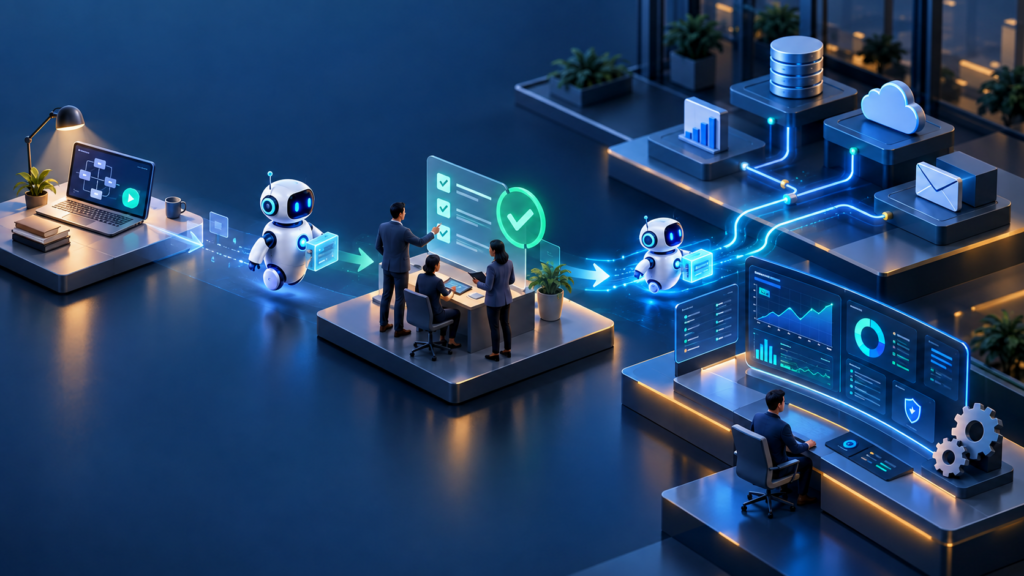

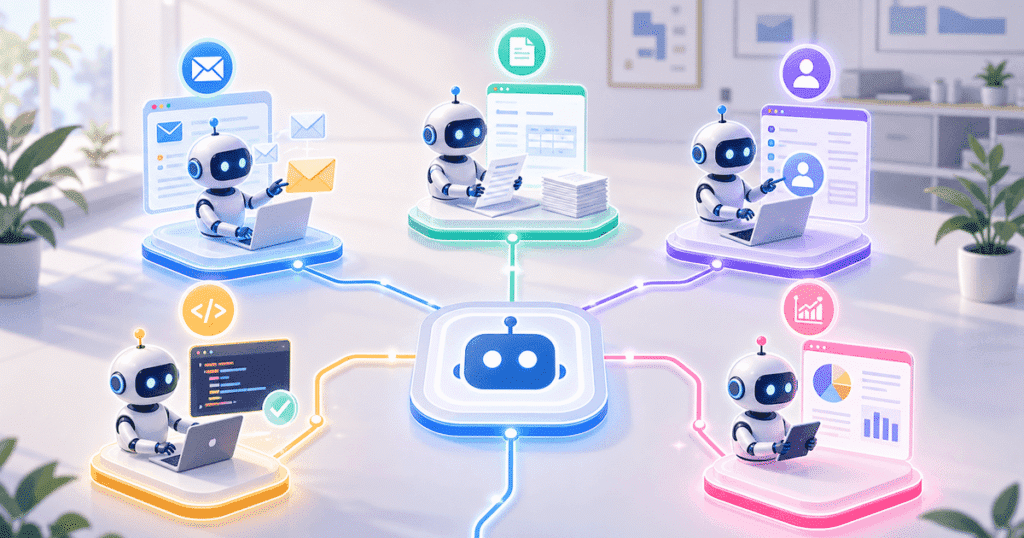
AI agent automation India business deployments have moved past the pilot stage. Companies across BFSI, manufacturing, and IT services are now running autonomous agents in production for lead qualification, invoice processing, support triage, code review, and competitive research. These are not chatbots that answer one question and stop. Instead, each agent completes a multi-step task end to end, often touching three or four systems before a human ever sees the output.
This shift matters because the agents below are not hypothetical roadmaps. They are workflows our engineering team has built, deployed, and tuned for clients in the last year. For a primer on what makes an AI agent different from a chatbot, see our deeper guide on how AI agents are reshaping business automation in India.
By Kurian Benny · Last updated: September 6, 2026
Key Takeaways
AI agent automation India business workflows now handle lead qualification, invoicing, support triage, code review, and market research without constant human input.
A well-built lead qualification agent can move a new inquiry from inbound email to a scored CRM record in under four minutes.
Invoice extraction agents cut manual data entry time because they read unstructured PDFs and populate ERP fields directly.
Every production agent needs human oversight checkpoints; full autonomy without review is the most common reason deployments fail.
Most Indian SMBs can deploy their first working agent in two to six weeks if the underlying data is already structured.
Agent 1: Inbound Lead Qualification Over Email
This agent reads a new inbound lead email, scores it against ideal customer criteria, and pushes a structured record into the CRM within minutes. A sales rep at a mid-sized SaaS company no longer opens a form submission, reads it, and manually types details into Salesforce or HubSpot. The agent does that instantly, and it flags hot leads for immediate follow-up.
The pipeline works in four steps: parse the inbound email or form payload, enrich it with company and contact data from a third-party API, score the lead against a rubric, and write the result to the CRM with a confidence note attached. Because each step is a discrete tool call, the agent can complete the entire chain in roughly four minutes from form submission to a CRM record a rep can act on.
📊 Key Stat: According to McKinsey’s State of AI research, organizations using AI agents for sales and marketing workflows report measurably faster lead response times than teams relying on manual triage — and speed to first response is one of the strongest predictors of conversion in B2B sales.
Agent 2: Invoice Extraction and ERP Data Entry
This agent reads scanned or PDF invoices, extracts line items, and writes structured records into the ERP without a human re-typing a single field. Finance teams at manufacturing and distribution clients used to spend hours each week on this exact task, because vendor invoices arrive in inconsistent formats with no shared template.
The agent combines a vision-capable model with a validation layer. It extracts vendor name, line items, tax codes, and totals, then cross-checks the extracted total against the line-item sum before writing to the ERP. If the numbers do not reconcile, the agent flags the invoice for human review instead of guessing. This validation step is what separates a production-ready agent from a demo — it builds in the case where the extraction is wrong, rather than assuming it never will be.
Agent 3: Customer Support Triage
This agent classifies an incoming support ticket, routes it to the right queue, and drafts a reply for a human agent to review before sending. It does not resolve every ticket itself. As a result, it removes the slowest part of the support workflow: reading, categorizing, and figuring out who should own each ticket.
The classification step tags the ticket by urgency, product area, and sentiment. Routing then assigns it to billing, technical, or account management queues based on those tags. Finally, the draft-reply step generates a first-pass response using prior resolved tickets as context, so the human agent edits rather than writes from a blank page. Teams running this pattern typically see first-response time drop because drafting, not deciding, was the bottleneck.
Agent 4: Code Review Automation for Engineering Teams
This agent reviews a pull request for security issues, style violations, and logic gaps before a human reviewer looks at it. It does not replace senior engineering judgment. Instead, it catches the mechanical issues — unhandled exceptions, missing null checks, inconsistent naming — so the human reviewer can focus on architecture and business logic — the same logic-versus-mechanics split that matters across any custom software development engagement, agent or not.
We have run this pattern internally using reasoning-capable models wired into the CI pipeline as a required check on every pull request. The agent posts inline comments directly on the diff, and it links each flagged issue to the specific line and the rule it violates. Engineering leads report that review cycle time drops because the first pass — the one that used to consume 20 minutes of a senior engineer’s attention — now takes the agent under two minutes.
Agent 5: Competitive Intelligence Briefing
This agent scans news sources, competitor websites, and industry forums every morning, then delivers a synthesized briefing before the leadership team’s first meeting. Marketing and product teams used to assign this task to a junior analyst, who spent two or three hours a day on manual searches.
The agent runs a scheduled job that queries multiple sources, deduplicates overlapping stories, and summarizes what changed since the previous day. It highlights pricing changes, new feature launches, and funding news specific to named competitors. Because the briefing arrives before 9 a.m. every day, leadership reviews it with morning coffee instead of waiting for a weekly digest that is already stale by the time it lands.
What’s Required to Deploy Each Agent
This is the part of AI automation work that determines whether a pilot survives contact with production. Every agent above needs three things before it goes into production: clean data, working integrations, and a defined oversight checkpoint. Skipping any one of these is why most agent pilots stall before they reach production.
- Structured or semi-structured source data. The lead and invoice agents need a CRM and ERP with stable field names; the support and code review agents need a ticketing system and a CI pipeline already in place.
- API access to the target systems. An agent that cannot write back to the CRM, ERP, or ticketing system is just a fancy summarizer — the value comes from the write, not just the read.
- A human-in-the-loop checkpoint for anything customer-facing or financial. The invoice agent flags reconciliation failures; the support agent drafts but does not send; the lead agent scores but a rep decides who to call first.
- A monitoring layer. Someone needs to know when the agent’s confidence drops or when it starts erroring out, because a silently failing agent is worse than no agent at all.
Common Mistakes Teams Make
Skipping the Human Review Checkpoint
Teams that let an agent act fully autonomously on customer-facing or financial tasks tend to regret it within weeks. A support agent that auto-sends replies without review will eventually send a wrong answer to an angry customer at scale, which is far worse than a slow human reply. Build the review checkpoint in from day one, not after the first incident.
Treating the Agent as a One-Time Build
An agent tuned for today’s invoice format breaks the moment a new vendor sends a differently formatted PDF. Because source data drifts constantly, teams that treat deployment as “done” rather than as an ongoing tuning process see accuracy decay within a quarter. Budget for monthly review cycles, not just the initial build.
Ignoring Integration Debt Before Starting
Some teams buy or build an agent before confirming their CRM or ERP even exposes a usable API. This sequencing mistake means the agent sits idle while the integration work — the part nobody budgeted for — gets done afterward. Audit your existing systems’ API access before selecting or scoping any agent.
Proof: What We Measured Building These Agents
We built the lead-qualification agent for a B2B SaaS client using a reasoning model as the scoring engine, wired through an orchestration layer that called the CRM’s REST API directly. The first version took 11 minutes end to end because the enrichment API call was synchronous and blocking. Parallelizing the enrichment and scoring steps — running them concurrently instead of sequentially — brought that down to under four minutes, the number we cite above.
On the invoice agent, our first reconciliation accuracy on real vendor invoices was 84%, well below what finance teams need to trust an automated pipeline. Adding the line-item cross-check step, where the agent recomputes the total and compares it against the printed total before writing to the ERP, pushed reconciliation accuracy past 97% in testing. That single validation step mattered more than any prompt tweak we tried.
🏆 Best Result: The code review agent caught a SQL injection vulnerability in a staging branch during internal testing — a class of bug that style linters do not catch but a reasoning-capable model trained on security patterns does.
Frequently Asked Questions
How much does it cost to deploy an AI agent for a business in India?
Costs vary by complexity, but a single-workflow agent — such as lead qualification or invoice extraction — typically costs less than building a custom internal tool from scratch, because the underlying model and orchestration layer are not built from zero. Expect the integration work, not the model itself, to be the larger share of the budget.
How long does it take to go from idea to a working AI agent?
Most Indian SMBs can deploy a first working agent in two to six weeks if the source systems already have usable APIs. Timelines stretch when the team needs to build new integrations or clean up inconsistent data first.
What’s the difference between an AI agent and a chatbot?
A chatbot answers a question in a conversation. An AI agent completes a multi-step task across multiple systems — reading data, calling tools, and writing results back — without a human directing every step.
Are there alternatives to building a custom AI agent?
Yes. Off-the-shelf automation tools handle simpler, rule-based tasks well, and they cost less upfront. However, they struggle with the judgment calls — like scoring a lead’s intent or classifying an ambiguous support ticket — that a reasoning-capable agent handles naturally.
What happens if the AI agent makes a mistake?
A well-designed agent fails safely: it flags low-confidence outputs for human review instead of acting on them. This is why the human-in-the-loop checkpoint described above is not optional for any agent touching customer communication or financial records.
Conclusion
AI agent automation India business workflows are no longer experimental. The five patterns above — lead qualification, invoice extraction, support triage, code review, and competitive intelligence — are running in production today, and each one removes a specific, well-defined bottleneck rather than promising to replace an entire team. The teams getting real results are the ones who pair the right agent with clean data, real integrations, and a human checkpoint where it matters.
If you are evaluating where an agent fits in your own operations, start with the workflow that has the most structured data and the clearest success metric — that is where deployment is fastest and ROI is easiest to prove. Quinoid’s agentic AI development team has built and shipped every pattern described in this post, and we scope new agent projects around the same data-integrations-oversight checklist outlined above.
Put these ideas into practice
Explore where AI could help your business.
Discuss your workflow, available data, and the result you want before deciding what to build.