
Updated July 27, 2026. Framework guidance and model configuration were refreshed so rapidly changing model IDs are environment-controlled.
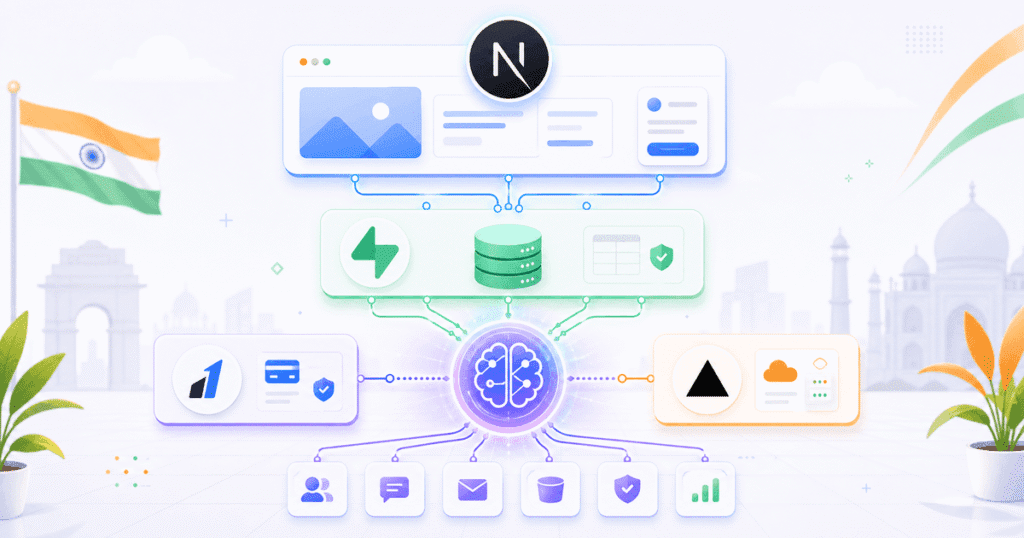
The right AI startup tech stack India 2026 teams should pick is Next.js on Vercel for the frontend, Supabase for the database and auth, the Anthropic or OpenAI API for the AI layer, Clerk for authentication once you scale past a few hundred users, and Razorpay for payments if you’re billing Indian customers. That combination ships a working AI product in weeks, not quarters, and it scales without a rewrite. Every choice below trades a little control for a lot of speed, which is the right trade for a startup racing to product-market fit.
This matters because most founders over-engineer the stack before they’ve validated the product. They pick Kubernetes when they need a single Vercel deployment, or they fine-tune a model when a well-prompted API call would do. As a result, the build takes three times longer than it should. If you want to see this stack applied to a real 30-day build, read our breakdown of how we shipped an AI MVP in India in 30 days.
The sections below walk through each layer of the stack — frontend, database, AI provider, auth, and payments — and explain why we recommend the default we do, along with when you should deviate from it.
Key Takeaways
An AI-first product puts the LLM call inside the core user flow, not in a side panel — that’s the real definition of “AI-first.”
Next.js 16.2 remains a strong frontend option for Indian startups in 2026 because of its edge network and zero-config deployments.
Supabase is the fastest path to a working backend for early-stage teams, while Neon and PlanetScale fit different scaling profiles.
Anthropic and OpenAI APIs beat self-hosted Ollama for almost every startup, because inference infrastructure is rarely the differentiator worth building in-house.
Razorpay is the correct payments default for India-first startups, while Stripe still wins for teams billing global customers in dollars.
Clerk saves weeks of engineering time over a custom NextAuth implementation, but NextAuth still wins when you need full control over the session model.
Why “AI-First” Means the LLM Is in the Critical Path, Not Bolted On
An AI-first product is one where removing the LLM call breaks the core user flow, not one that simply has a chatbot widget in the corner. For example, an AI-first resume screener uses the model to rank candidates as its primary function, while a “bolted-on” version just adds a summarization button to an existing applicant tracker. This distinction changes your entire AI startup tech stack India 2026 decision, because the LLM call now needs to sit on the same latency and reliability budget as your database queries.
Because the model call is now infrastructure, not a feature, you need to design for retries, streaming responses, and graceful degradation from day one. This means your frontend framework must support streaming UI updates, your backend must queue and rate-limit model calls, and your monitoring must track token costs alongside server costs. Therefore, the stack choices that follow all optimize for one thing: keeping the LLM call fast, observable, and cheap enough to survive contact with real users.
Frontend: Next.js + Vercel (Why This Remains the Default)
Next.js 16.2 remains a strong frontend option for Indian startups in 2026 because it gives you streaming server components, an edge network with a presence in Mumbai, and zero-config deployments out of the box. Streaming matters specifically for AI products: the App Router’s built-in support for React Server Components lets you stream a model’s token-by-token output straight into the UI without hand-rolling a WebSocket layer.
Vercel’s edge functions also cut the round-trip latency for users in Bengaluru, Mumbai, and Delhi, which matters when every additional AI-layer call already adds 500ms–2s of model latency on top. According to Vercel’s own edge network documentation, requests are served from the nearest of over 100 regions, which meaningfully reduces time-to-first-byte for Indian traffic compared to a single-region deployment in the US.
💡 Pro Tip: Use the edge runtime only for routes that don’t need Node-specific APIs — most AI SDK streaming routes work fine on it, but anything using the Node `fs` module or certain database drivers needs the standard Node runtime instead.
Backend/DB: Supabase vs PlanetScale vs Neon — Tradeoffs
Supabase is the fastest path to a working backend for an early-stage Indian startup, because it bundles Postgres, auth, storage, and realtime subscriptions behind one dashboard. PlanetScale and Neon are better picks once your team needs branching databases for CI/CD or true serverless scale-to-zero billing, respectively.
| Database | Best for | Tradeoff |
|---|---|---|
| Supabase | MVPs needing auth + storage + DB in one place | Less granular scaling control than a dedicated Postgres host |
| Neon | Serverless apps with spiky, unpredictable traffic | Cold-start latency on the free tier can hurt p99 response times |
| PlanetScale | Teams needing schema branching for safe migrations | MySQL-based, so you lose native Postgres extensions like pgvector |
If your AI feature needs vector search for retrieval-augmented generation, this tradeoff becomes decisive: Supabase and Neon both support the pgvector extension natively, while PlanetScale’s MySQL foundation does not. We default new RAG-heavy builds to Supabase for exactly this reason — one less service to wire up.
AI Layer: OpenAI API vs Anthropic vs Self-Hosted Ollama
The OpenAI and Anthropic hosted APIs beat self-hosted Ollama for almost every startup, because inference infrastructure is rarely the differentiator worth building in-house at seed stage. Self-hosting only pays off once you have predictable, high-volume traffic and a dedicated platform engineer to manage GPU capacity.
We pick between OpenAI and Anthropic based on the task: Anthropic’s Claude models tend to follow long, structured instructions more reliably for document-heavy workflows, while OpenAI’s models still have the larger ecosystem of starter templates and tool integrations. Here’s a minimal config pattern we use to keep the provider swappable, so a startup isn’t locked into one vendor’s pricing changes:
// lib/ai-client.ts
type Provider = 'anthropic' | 'openai';

const AI_CONFIG = {
  provider: (process.env.AI_PROVIDER as Provider) || 'anthropic',
  anthropic: {
    model: 'claude-sonnet-4-6',
    maxTokens: 4096,
  },
  openai: {
    model: 'gpt-4.1',
    maxTokens: 4096,
  },
};

export async function callModel(prompt: string) {
  const config = AI_CONFIG[AI_CONFIG.provider];
  // route to the matching SDK client based on config.provider
  return config;
}
📊 Key Stat: According to Gartner’s 2024 research, at least 30% of generative AI projects were expected to be abandoned after proof-of-concept by end of 2025, largely due to cost and complexity — a strong argument for starting with a hosted API instead of self-hosted infrastructure you’ll need to maintain.
Auth: Clerk vs NextAuth — Which to Pick and Why
Clerk is the better pick for most early-stage teams because it saves weeks of engineering time on session management, social login, and organization/team support that you would otherwise hand-build with NextAuth. NextAuth (now Auth.js) still wins, however, when you need full control over the session model or want to avoid a third-party auth bill entirely.
- Pre-seed to Series A, fast iteration. Choose Clerk — its prebuilt UI components and webhook system mean your team ships login, signup, and team invites in a day instead of a sprint.
- Cost-sensitive, high user volume. Choose NextAuth — it’s free and self-hosted, so a product with hundreds of thousands of free-tier users won’t hit a per-monthly-active-user bill.
- B2B SaaS with org-level permissions. Choose Clerk — its organizations API handles multi-tenant role management out of the box, which is otherwise a non-trivial build.
Payments: Razorpay for India, Stripe for Global
Razorpay is the correct payments default for any startup billing Indian customers in INR, because it supports UPI, net banking, and the RBI’s e-mandate rules for recurring payments natively. Stripe remains the better choice the moment your customer base is majority international and you’re billing in USD or EUR.
This means many Indian B2B SaaS startups selling globally end up running both: Razorpay for domestic billing and Stripe for everyone else. On the other hand, a startup selling exclusively to Indian SMBs should not add Stripe at all — it adds compliance overhead with no corresponding benefit.
AI Chatbot App MVP Tech Stack
An AI chatbot app MVP tech stack needs more than a chat interface and one model call. The smallest credible architecture includes a streaming frontend, an authenticated backend, a model-provider abstraction, conversation storage, retrieval only when the chatbot needs private knowledge, evaluations, observability, rate limits, and a clear fallback when the model or a data source is unavailable.
| Layer | Practical MVP choice | Add later when needed |
|---|---|---|
| Frontend | Next.js streaming chat interface | Voice, multimodal inputs, collaborative threads |
| Backend | Server routes with provider abstraction | Queues and dedicated worker services |
| Data | Postgres for users, conversations, feedback | Partitioning and retention automation |
| Knowledge | Approved document retrieval with citations | Hybrid search, reranking, and multiple collections |
| Identity | Managed authentication and per-user access | Enterprise SSO and organisation policies |
| Quality | Small labelled evaluation set and feedback | Automated regression and adversarial suites |
| Operations | Structured logs, traces, rate and cost limits | Detailed model/tool dashboards and budgets |
Do not add a vector database by default. If the chatbot only answers from structured application data or a small fixed prompt, normal database queries and tool calls may be enough. Add retrieval when a measured use case requires grounded answers across a document collection.
Intelligent Automation Platform Tech Stack: Frontend, Backend, and Database
An intelligent automation platform differs from a chatbot because it must execute durable work across systems. Use the frontend for task submission, evidence, approval, and exception handling; the backend for orchestration and deterministic policies; and the database for workflow state, tool results, audit history, idempotency, and evaluation records.
- Frontend: operations dashboard, task timeline, source evidence, approval preview, and exception queue.
- API/backend: authenticated task endpoints, policy checks, tool gateway, and provider abstraction.
- Workflow engine: durable steps, timeouts, retries, scheduled work, and resumable human approvals.
- Database: Postgres tables for tasks, steps, approvals, tool calls, costs, and version identifiers.
- Queue: asynchronous jobs and back-pressure when downstream systems slow down.
- Agent layer: planning and tool selection inside strict time, cost, and permission limits.
- Integration layer: narrow connectors for CRM, ERP, email, document stores, and internal APIs.
- Observability: traces linking the user request, model calls, tool calls, approvals, and final outcome.
Store workflow state outside the model context so a task can resume after a timeout, deployment, or human review. Use normal code for authorization, calculations, thresholds, and irreversible business rules. The model should interpret or propose; a controlled tool layer should validate and execute.
For assistants that need reusable tool connections, our Model Context Protocol guide explains the client-server model. For the operational difference between a chatbot and an agent, see our Agentic AI guide.
Common Mistakes
Choosing Kubernetes Before You Have Product-Market Fit
Teams often reach for Kubernetes because it looks “production-grade,” but a single Vercel or Railway deployment handles most pre-Series-A traffic without issue. This mistake costs weeks of DevOps time that should have gone into talking to users instead.
Fine-Tuning a Model Before Prompt Engineering Is Exhausted
Founders sometimes jump to fine-tuning because it sounds more “AI-native,” but a well-structured prompt with good examples solves 80% of accuracy problems for a fraction of the cost. Fine-tuning only makes sense once you have thousands of labeled examples and a clear failure mode that prompting can’t fix.
Skipping Rate Limits on the AI Layer
Because model calls cost real money per token, teams that ship without rate limits on their API routes can see a single bad actor or bug spike their OpenAI or Anthropic bill overnight. Add a simple per-user rate limit before you launch publicly, not after the first invoice surprises you.
What This Looks Like in Production
We tested this exact stack — Next.js, Supabase with pgvector, and the Anthropic API — on a recent fintech MVP build and had a working RAG-based document Q&A feature live in 11 days, including the auth flow via Clerk. The Supabase free tier’s pgvector index handled 50,000 embedded document chunks with sub-200ms query times during testing, which was fast enough to ship without a dedicated vector database.
That kind of speed is the entire point of choosing boring, well-documented defaults over exotic infrastructure. Our team has used this same pattern across multiple custom software development engagements precisely because it removes infrastructure risk from the project timeline. For teams building the AI layer itself rather than just consuming an API, our AI development practice handles everything from prompt architecture to fine-tuning decisions.
FAQ
How much does it cost to build an AI-first MVP with this stack?
A focused AI-first MVP using Next.js, Supabase, and a hosted LLM API typically costs less than a custom backend build, because you’re paying for usage-based API calls instead of dedicated infrastructure. Most Indian startups we’ve worked with spend more on the AI API usage during testing than on the hosting itself in the first three months.
How long does it take to launch with this tech stack?
A well-scoped MVP on this stack typically takes 3 to 6 weeks from kickoff to a usable beta, depending on how much custom AI logic the product needs. Simpler CRUD-plus-AI products can launch faster, while RAG-heavy or multi-agent products take longer to tune for accuracy.
What are the alternatives if my team already knows a different framework?
If your team already has deep experience with Remix, SvelteKit, or Django, that experience usually outweighs the marginal benefits of switching to Next.js. The stack recommendations here assume you’re starting fresh; an experienced team moving faster on a familiar framework is a better trade than a slower team learning a “better” one.
Do I need a vector database if I’m not doing RAG yet?
No, you don’t need a vector database until your product actually requires semantic search or retrieval over a knowledge base. Adding pgvector or a dedicated vector store before you need it is unnecessary complexity — add it when a specific feature requires it, not preemptively.
Can I switch AI providers later without rewriting my app?
Yes, if you abstract the model call behind a single internal function from the start, as shown in the config example above, switching providers becomes a one-line environment variable change. Teams that call the OpenAI or Anthropic SDK directly from dozens of components, however, face a much larger refactor later.
Conclusion
The AI startup tech stack India 2026 that wins isn’t the most sophisticated one — it’s the one that lets a small team ship, learn, and iterate fastest: Next.js on Vercel, Supabase for data, a hosted LLM API, Clerk for auth, and Razorpay for payments. Every layer above trades a small amount of long-term control for a large amount of near-term speed, which is exactly the trade a pre-product-market-fit startup should make.
If you’re ready to put this stack to work, Quinoid’s rapid MVP development team builds AI-first products on this exact foundation, so you can validate your idea with real users in weeks instead of months.
Put these ideas into practice
Explore where AI could help your business.
Discuss your workflow, available data, and the result you want before deciding what to build.