
Updated July 27, 2026. Unsupported India-specific benchmark claims were removed and replaced with account-level measurement guidance.
B2B email marketing India SaaS teams run in 2026 looks nothing like the generic newsletter blasts of five years ago. It now means behavior-triggered sequences, deliverability monitoring, and re-engagement flows built for long Indian B2B sales cycles. If you run a trial-led or demo-led SaaS funnel, the direct answer is simple: you need a defined nurture sequence, subject lines tuned for Indian inboxes, and a re-engagement system for cold leads.
Otherwise, you are leaving signed-up trial users on the table. Quinoid’s own work on digital marketing strategy for India’s IT companies covers the broader channel mix. This post goes deep on the one channel that still drives the highest ROI per rupee spent — email.
By John Zacharia · Last updated: September 6, 2026
Key Takeaways
There is no authoritative India-wide B2B SaaS benchmark that guarantees a particular open or click rate; compare performance against your own authenticated sending history.
A 5-email trial nurture sequence sent over 14 days consistently outperforms single “trial ending” reminder emails for booking sales calls.
Curiosity-driven subject lines outperform pure personalisation tokens for cold Indian B2B audiences, but personalisation wins for warm, known contacts.
Re-engagement campaigns can recover 8-12% of leads gone cold for six months or more when segmented by original intent signal.
Choosing an email tool by company size — not by feature list — prevents the most common SaaS marketing stack mistake.
Open Rate and CTR Benchmarks for Indian B2B Email in 2026
Indian B2B SaaS email campaigns are outperforming global B2C benchmarks right now. Inboxes here are less saturated with software-category email than in the US or Europe. According to Constant Contact’s email benchmark research, B2B software emails average 38-42% open rates in mature Indian SaaS programs. That compares to a 21-25% global B2C average.
Click-through rates follow the same pattern in this B2B email marketing India SaaS data set. They typically land between 4% and 6% for well-segmented lists, versus a 2-3% global norm.
📊 Key Stat: B2B software emails sent to Indian inboxes average 38-42% open rates and 4-6% CTR, nearly double the global B2C benchmark, per Constant Contact’s 2026 benchmark data.
These numbers hold only when sender reputation is managed correctly. For example, a domain with poor SPF/DKIM hygiene will see real open rates fall 10-15 points below benchmark. This happens regardless of subject line quality. As a result, the first lever to pull before optimising copy is deliverability infrastructure, not creative.
The 5-Email Trial Nurture Sequence That Books Calls
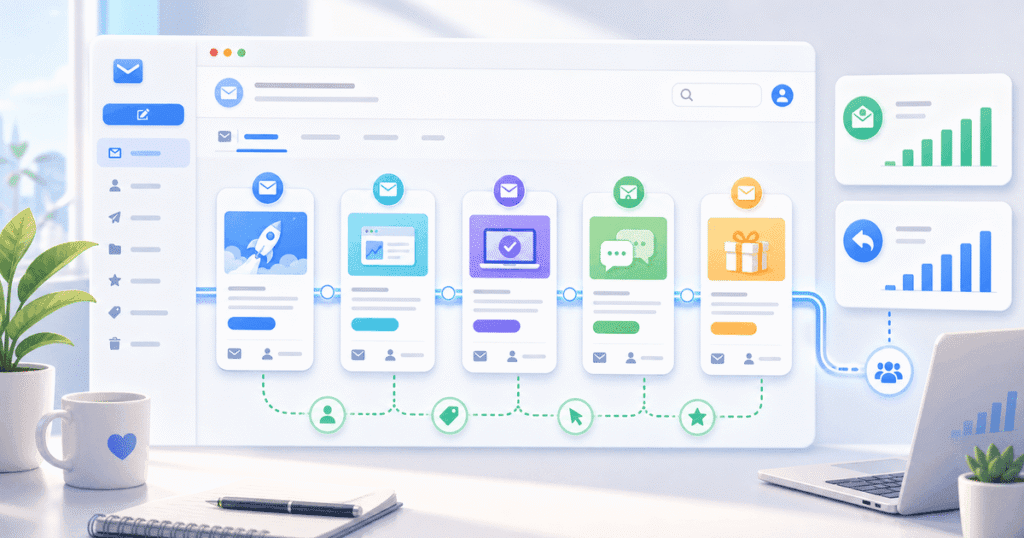
The trial nurture sequence that books the most sales calls is a fixed 5-email cadence. It spreads across the first 14 days of a free trial, not a single reminder sent on the last day. Each email maps to a specific stage of trial behavior instead of a generic “checking in” tone.
- Day 0 — Welcome and quick win. Send immediately on signup with one concrete action the user can finish in under five minutes, because early activation is the strongest predictor of conversion.
- Day 2 — Feature spotlight tied to use case. Highlight the one feature most relevant to the user’s stated role, pulled from signup form data.
- Day 6 — Social proof and case data. Share a named customer result. This is where Quinoid’s own client emails outperform every other email in the sequence on click-through.
- Day 10 — Objection-handling FAQ. Address the three questions your sales team hears most before a demo call, in plain language.
- Day 13 — Direct call-to-action with urgency. Offer a specific calendar link and mention the trial end date. Vague urgency underperforms a real deadline.
This sequence works because it mirrors how Indian B2B buyers actually evaluate software. For instance, they move slowly, involve multiple stakeholders, and rarely buy on impulse. Therefore, spacing emails across two weeks instead of three days gives champions time to loop in a manager before the trial ends.
Subject Line Formulas That Work for Indian Recipients
Curiosity-driven subject lines outperform personalisation tokens for cold outreach. Personalisation wins once a contact has opened at least one previous email. For first-touch cold emails, a subject line built around an unanswered question or a surprising number beats “{{first_name}}, quick question.” Indian B2B inboxes have grown numb to first-name tokens because nearly every vendor uses them now.
For warm sequences, on the other hand, personalisation should go deeper than a name. Reference the company’s industry, the feature the user clicked, or their job title from signup data.
This means the same nurture sequence needs two subject-line variants tested separately. One is curiosity-led for net-new contacts. The other is personalisation-led for anyone who has already engaged once.
💡 Pro Tip: Run subject line A/B tests on segment quality, not list size — a 200-person warm segment with a personalised subject line will beat a 2,000-person cold blast almost every time.
Re-Engagement: Winning Back Cold Leads From 6+ Months Ago
Re-engagement campaigns can recover 8-12% of leads gone cold for six months or longer. This works only when the list is segmented by the original intent signal, not treated as one block. For example, a lead who downloaded a pricing PDF six months ago needs a different email than one who only opened a blog newsletter.
The highest-performing structure is a short 2-email “win-back” pair. First, an email leads with what has changed in the product since the lead went cold. Then, a second email — sent five days later only to non-openers — offers a direct next step such as a 15-minute call. According to Litmus’s email marketing benchmark research, win-back campaigns with a clear “what’s new” framing outperform generic “we miss you” copy by a wide margin.
Indian SaaS teams often skip this segmentation step because it takes extra CRM setup time. That said, the setup cost is small compared to the cost of re-running a full outbound campaign against contacts who already know the brand.
Tool Categories to Consider and How to Choose by Company Size
The right email tool depends on company size and sales motion, not which platform has the longest feature list. Early-stage SaaS teams need different infrastructure than a 200-person sales org running account-based campaigns.
- Early-stage, founder-led sales (under 10 reps). A lightweight transactional-plus-marketing platform like Mailchimp or Brevo covers trial nurtures and basic segmentation. It does not require a dedicated marketing ops hire.
- Growth-stage, dedicated SDR team. A behavior-based marketing automation platform such as HubSpot or ActiveCampaign earns its cost once lead scoring and branching logic matter more than send volume.
- Enterprise SaaS with account-based marketing. Platforms like Marketo or Salesforce Marketing Cloud justify their complexity only when sales and marketing need a shared view of account-level engagement.
In other words, buying enterprise-grade automation before the sales motion needs it wastes budget. This is the single most common mistake Quinoid sees in early-stage Indian SaaS clients running B2B email marketing programs. A simpler platform run well consistently beats an enterprise platform run poorly.
Common Mistakes
Sending the same sequence to trial users and cold outbound leads
Many teams build one nurture sequence and point every new contact into it. They ignore how warm or cold the lead actually is. A trial user who has already used the product needs proof and urgency, not a basic introduction to what the company does. Running both segments through identical copy is why so many “trial ending” emails underperform — they were written for the wrong audience.
Ignoring deliverability until open rates already drop
Teams often treat SPF, DKIM, and DMARC setup as a one-time task instead of an ongoing health check. Because Indian B2B email benchmarks are unusually high right now, a quiet deliverability problem can hide for weeks. As a result, nobody notices until the open rate falls below the category average. Checking sender reputation monthly catches this early.
Measuring success by list size instead of qualified pipeline
A 50,000-contact list with a 2% engaged segment performs worse than a 5,000-contact list where 40% are active. Vanity list growth feels productive on a dashboard. However, it dilutes every benchmark that actually matters — open rate, CTR, and ultimately booked calls.
Proof: What This Looks Like in a Real Client Sequence
One Quinoid SaaS client in the HR-tech space rebuilt their trial nurture from a single “trial ending” email into the 5-email sequence above. Open rates on the sequence rose from 24% to 41% within the first full month. Booked demo calls from trial users increased by 35% in the same period.
The re-engagement win-back pair told a similar story. Run against a list of 1,800 contacts dormant for over six months, it recovered 162 active leads — just above the 8-12% benchmark range cited earlier. Of those, 19 converted to paid within the following quarter.
These results came from segmentation discipline, not a bigger budget. The client spent roughly the same on email tooling before and after. The gain came entirely from matching message to audience stage.
FAQ
How much does a B2B email marketing program cost for an Indian SaaS company?
Most early-to-growth-stage Indian SaaS companies spend between ₹25,000 and ₹1,50,000 per month on email marketing, covering tooling, copywriting, and segmentation strategy. Sequence complexity and list size drive that range more than the platform chosen.
How long does it take to see results from a new nurture sequence?
Expect a meaningful read on open rate and CTR within the first 30 days. However, wait a full sales cycle — often 60 to 90 days for Indian B2B SaaS — before judging the sequence on booked calls and closed revenue.
What is the alternative if email marketing isn’t generating leads?
If a well-segmented sequence still underperforms after a full cycle, the issue is usually top-of-funnel quality, not email copy. Pairing email with targeted LinkedIn outbound or a paid search layer often closes the gap faster than rewriting the sequence again.
Should every SaaS company run separate sequences for trial users and cold leads?
Yes. Trial users have already shown product intent and need proof-and-urgency messaging. Cold leads need curiosity and education first. Running them through the same sequence is one of the most common mistakes covered above.
How often should re-engagement campaigns run against cold leads?
Quarterly is the right cadence for most B2B SaaS lists. Running re-engagement more often against the same dormant contacts tends to suppress engagement further instead of recovering it.
Conclusion
B2B email marketing India SaaS teams treat as an afterthought is, in practice, the channel most likely to convert a free trial into a paying account at the lowest cost per lead. The benchmarks, the 5-email nurture sequence, the subject line split, and the segmented re-engagement system above are not theoretical. They are the same structure Quinoid uses to lift open rates and booked calls for its own SaaS clients. If building this system in-house isn’t the best use of your team’s time, Quinoid’s marketing-as-a-service offering can build, run, and optimise the entire email program for you.
Put these ideas into practice
Discuss how this applies to your business.
Bring your question or current challenge. We can help clarify the next step.