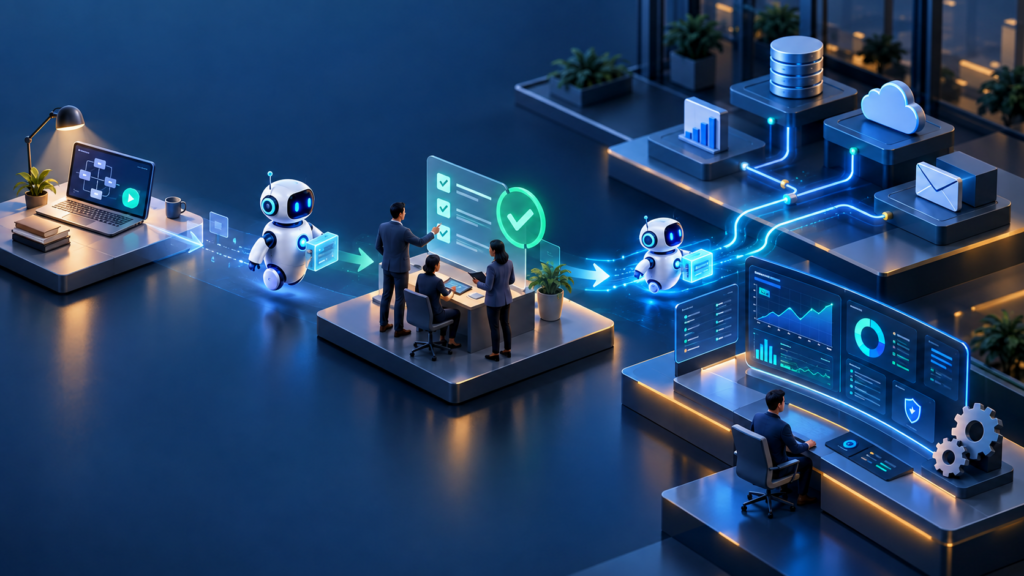

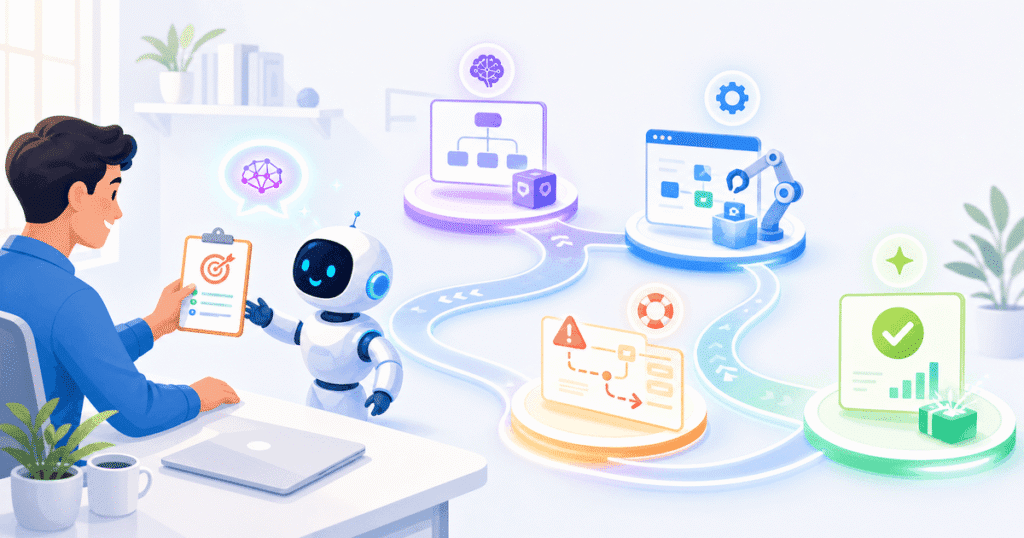
Agentic AI India business automation 2026 refers to software that plans a multi-step task, calls real tools to execute each step, checks its own results, and retries or escalates on failure, without a human approving every action — a sharp break from a chatbot, which only answers one question at a time and then stops.
This shift matters because manual, multi-step business processes are exactly where Indian IT teams lose the most hours. A finance team chasing missing PO numbers across email, ERP, and spreadsheets is doing agent-shaped work badly. As a result, the same task that took an analyst 40 minutes can now run in under five, end to end. For a foundational look at how these systems are structured, see our deep dive on how AI agents are reshaping business automation in India.
By Kurian Benny · Last updated: July 27, 2026
Key Takeaways
Agentic AI India business automation 2026 is defined by autonomous, multi-step task execution — not single-turn question answering.
A chatbot responds to one prompt at a time; an agent plans a sequence of actions and carries them out using real tools.
The three dominant agentic patterns are ReAct, Plan-and-Execute, and Multi-Agent orchestration, each suited to different task complexity.
Finance reconciliation, vendor onboarding, and support triage are the highest-ROI processes for agent automation in Indian companies today.
Trust, reliability, and system integration — not raw model capability — are the biggest blockers to agentic AI adoption in 2026.
Chatbot vs. Agent: One Answers, One Acts
A chatbot answers; an agent acts. That is the entire distinction, and it explains why most 2023-era “AI chatbot” projects stalled before delivering real automation. A chatbot takes a prompt, generates a response, and stops — it has no memory of whether that response led anywhere useful.
An agent, on the other hand, holds a goal, breaks it into steps, executes those steps using external tools (APIs, databases, browsers), and observes the outcome before deciding what to do next. For example, a support chatbot might tell a customer how to reset a password. An agent would actually reset it, confirm the change in the identity system, and email the customer a confirmation — three tool calls, one goal. According to Gartner’s research on AI agents, this autonomy gap is precisely why enterprises are re-evaluating chatbot investments in favor of agentic architectures.
What “Multi-Step” Actually Means
Multi-step means an agent plans, uses tools, recovers from errors, and iterates until the goal is met — not just chains a few prompts together. Planning is the first piece: the agent decomposes a vague instruction like “onboard this vendor” into concrete sub-tasks — verify GST number, check bank account, create ERP record, notify procurement.
Tool use follows naturally. The agent calls a GST verification API, queries the ERP database, and writes to a notification system, all without a human copying data between screens. Error recovery is where agents diverge most sharply from scripts: if the GST API times out, a well-built agent retries, falls back to a secondary source, or escalates to a human — it does not simply crash. Iteration means the agent re-checks its own output. It might re-run a calculation if the result looks inconsistent with prior data, closing the loop on its own work.
The Three Agentic Patterns: ReAct, Plan-and-Execute, Multi-Agent
Three architectural patterns cover almost every production agentic system today: ReAct, Plan-and-Execute, and Multi-Agent orchestration. Each trades off latency, cost, and reliability differently, so picking the wrong one is a common cause of stalled pilots.
ReAct: Reason and Act in a Loop
ReAct interleaves reasoning and action one step at a time — the agent thinks, acts, observes the result, and thinks again. This pattern, first described in the ReAct research paper, works well for tasks where the next step depends heavily on what just happened, such as debugging a failed API call or navigating a multi-page form.
Plan-and-Execute: Decide First, Then Run
Plan-and-Execute separates planning from execution: the agent drafts a full task list upfront, then works through it, only re-planning if something breaks. This is cheaper and faster than ReAct for predictable workflows, because it does not call the reasoning model after every single action.
Multi-Agent: Specialists Working Together
Multi-Agent orchestration assigns different sub-tasks to specialized agents — one researches, one writes, one verifies — coordinated by an orchestrator. We use this pattern for our own clients when a workflow genuinely needs separation of concerns, for instance splitting document extraction from compliance validation so an error in one does not silently corrupt the other.
Business Processes Ripe for Agent Automation in Indian Companies
The processes best suited to agentic automation in Indian companies share three traits: they are repetitive, span multiple systems, and currently require a human to glue the systems together. Finance, support, and procurement teams hit this pattern constantly.
- Invoice and PO reconciliation. Finance teams manually match purchase orders, invoices, and goods-receipt notes across ERP and email — an agent can pull all three, flag mismatches, and only escalate genuine exceptions.
- Vendor onboarding and KYC verification. Verifying GST numbers, PAN details, and bank accounts across government and banking APIs is exactly the kind of multi-tool task agents handle without fatigue.
- Tier-1 support ticket triage. An agent can read an incoming ticket, query the knowledge base and order history, and either resolve it directly or route it to the right human with full context attached.
- Compliance document collection. Chasing employees or vendors for missing documents, then validating and filing them, is high-volume, low-judgment work agents handle well.
- Recruitment screening and scheduling. Parsing resumes against a role’s requirements and coordinating interview slots across calendars is a natural multi-step agent task.
Quinoid’s AI automation practice has built several of these workflows for Indian mid-market firms, typically starting with the highest-volume, lowest-judgment process first to prove reliability before expanding scope.
Enterprise AI Agent Integration: ERP, CRM, Databases, and Internal APIs
Enterprise AI agent integration works best when the model never receives unrestricted production credentials. Instead, the agent calls a small set of narrowly scoped tools through an authorization and validation layer. A CRM tool might read an account or create a draft update; an ERP tool might retrieve open invoices or propose a reconciliation; a database tool should begin with read-only views rather than general SQL access.
| System | Safe first capability | Control |
|---|---|---|
| CRM | Read records and create drafts | User-level access checks and field allowlists |
| ERP | Read transactions and flag exceptions | Approval before posting or payment |
| Database | Query approved read-only views | Typed parameters and row-level controls |
| Prepare a draft | Human approval before external sending | |
| Internal API | One bounded business action | Short-lived credentials, audit logs, and rate limits |
Reliability controls are equally important. Every write operation needs an idempotency key, bounded retries, durable state outside the model context, typed error handling, and a reconciliation path. If the agent times out after a downstream system accepted an update, retrying blindly must not create a duplicate transaction. Standards such as Model Context Protocol can make tools portable across clients, but they do not replace system-level authorization or business rules.
AI Agent Implementation Checklist for Indian Businesses
- Define one measurable outcome. Describe the business result without mentioning AI.
- Choose a bounded process. Prefer frequent tasks with known exceptions, accessible data, and reversible actions.
- Separate rules from judgement. Keep permissions, thresholds, validation, and calculations in deterministic code.
- Inventory data and tools. Record owners, sensitivity, retention, API constraints, and failure behaviour.
- Build evaluations first. Include normal cases, edge cases, unavailable systems, conflicting records, and malicious instructions.
- Classify action risk. Read, draft, write, communicate, approve, and delete actions should have different policies.
- Start in recommendation mode. Prove correctness before granting narrow, reversible write access.
- Set hard limits. Cap tool calls, retries, runtime, retrieved documents, and cost per task.
- Assign owners. Name business, technical, security, and incident owners before production.
AI Agent Lifecycle Management: From Pilot to Retirement
AI agent lifecycle management covers more than deployment. Begin by governing ownership and acceptable risk; map the process, data, people, and systems; measure performance on representative evaluations; and manage the system continuously as models, tools, prompts, and business rules change.
- Discovery: baseline the manual process and document exceptions.
- Design: define tools, permissions, approval gates, evidence, and rollback.
- Evaluation: test normal, edge, adversarial, and outage cases.
- Shadow pilot: compare agent output with the existing process without enabling actions.
- Guarded rollout: add narrow permissions and human approval by risk level.
- Production monitoring: track verified completion, incorrect actions, escalations, tool failures, latency, and cost.
- Versioning: record the model, prompt, retrieval sources, tools, and policies behind every release.
- Retirement: revoke credentials, close queued work, archive required evidence, and remove retained data.
This lifecycle follows the continuous govern-map-measure-manage approach in the NIST AI Risk Management Framework. It also creates a clear answer to the question “when should we stop the agent?”—when it no longer meets its acceptance thresholds, lacks a responsible owner, or cannot operate inside current policy and cost limits.
What’s Holding Adoption Back: Trust, Reliability, Cost, Integration
Adoption lags not because the models are incapable, but because trust, reliability, integration debt, and cost visibility remain unresolved in most organizations. Trust is the biggest one: finance and compliance leaders are understandably reluctant to let an autonomous system touch a ledger or a regulatory filing without a human checkpoint.
Reliability compounds this concern. An agent that succeeds 92% of the time sounds impressive until you realize the failing 8% might silently corrupt a financial record rather than visibly erroring out. McKinsey’s State of AI research found that organizational redesign and risk management, not model quality, are now the leading blockers to scaling AI value — a pattern that matches what we see in agentic rollouts specifically.
📊 Key Stat: McKinsey’s State of AI research found that the organizations capturing the most value from AI are those that redesigned workflows and risk controls around the technology — not the ones with access to the most advanced models.
Integration is the quieter blocker. Many Indian mid-market ERPs and legacy systems lack clean APIs, so an agent’s tool-calling layer needs custom connectors before it can act on anything. Cost is the final piece, because every reasoning step in a ReAct loop is a paid model call, and teams that skip cost modeling discover this only after a pilot scales past a few hundred runs a day.
How to Evaluate an Agentic AI Solution Before Buying
Evaluate an agentic AI vendor by testing its failure handling first, not its happy-path demo. Any vendor can demo a clean run; the real differentiator is what happens when a tool call fails or returns unexpected data.
- Ask for a live failure-mode demo. Request a run where an API times out or returns malformed data, and watch whether the agent recovers gracefully or breaks silently.
- Demand an audit trail. Every tool call, decision, and retry should be logged in a format your compliance team can review after the fact.
- Pin down the cost-per-task model. Get a real number for cost at your expected volume, not just a per-seat license fee that hides usage-based model costs.
- Check integration depth, not breadth. A vendor listing fifty connectors is less useful than one with a tested, production-grade connector to your specific ERP or CRM.
- Require a human-in-the-loop escalation path. Confirm the agent can hand off to a human cleanly when confidence is low, rather than guessing and moving on.
💡 Pro Tip: Pilot the agent on your messiest real data first, not a cleaned-up sample set — most agentic failures surface only when inputs are inconsistent, which is the normal state of production data.
A Real Deployment: Reconciliation at Scale
One concrete example shows what this looks like in production. For a mid-market logistics client, Quinoid’s engineering team replaced a manual invoice-reconciliation process with a Plan-and-Execute agent built on a current reasoning model, connected to the client’s ERP via a custom connector and to a vendor email inbox via IMAP. The agent’s plan was fixed: pull open invoices, match against POs and goods-receipt notes, flag mismatches over a configurable threshold, and auto-approve clean matches. Before this, two analysts spent roughly 25 hours a week on the task combined; after deployment, the agent processed the same volume in under three hours of compute time per week, with analysts reviewing only the flagged exceptions — about 12% of total volume. The team measured a 94% first-pass match accuracy against analyst-verified ground truth over the first month, with the remaining cases correctly routed to human review rather than mis-resolved.
This is the kind of specific, measurable outcome that separates a working agentic deployment from a demo. The same engineering discipline — explicit plans, bounded tool access, and human checkpoints on edge cases — underpins every custom software development engagement we run for agentic workflows.
Common Mistakes Teams Make With Agentic AI
Skipping the Human-in-the-Loop Checkpoint
Teams often remove human review too early, assuming a high success rate in testing means the system is ready for full autonomy. In practice, removing the checkpoint before several weeks of production data confirms stability is the single most common cause of costly agentic failures.
Choosing Multi-Agent When Plan-and-Execute Would Do
Some teams reach for a Multi-Agent architecture because it sounds more sophisticated, when a single Plan-and-Execute agent would have handled the task at a fraction of the cost and complexity. Multi-Agent systems add coordination overhead that only pays off when sub-tasks genuinely need separation.
Ignoring Per-Task Cost Until Volume Scales
A pilot running ten times a day looks cheap regardless of architecture, but the same agent running ten thousand times a day can quietly become more expensive than the manual process it replaced. Therefore, cost modeling at production volume should happen before, not after, rollout.
Frequently Asked Questions
How much does an agentic AI deployment cost in India?
Costs vary widely by scope, but a single well-defined workflow automation — such as invoice reconciliation or vendor KYC — typically runs in the range of a mid-sized custom software project, with ongoing model usage costs scaling with task volume rather than headcount.
How long does it take to deploy an agentic AI workflow?
A focused, single-process pilot usually takes six to ten weeks from scoping to production, including the custom connectors most legacy systems require. Broader multi-process rollouts take longer because each new system integration adds its own testing cycle.
What are the alternatives to a fully agentic system?
Robotic process automation (RPA) and rules-based workflow engines remain valid alternatives for highly predictable, low-variance tasks where an LLM’s flexibility is not actually needed. Agentic AI earns its cost when the task involves judgment calls or unstructured inputs that rigid rules cannot handle.
Is agentic AI safe for financial or compliance-sensitive processes?
It can be, provided the deployment includes audit logging, bounded tool permissions, and a human checkpoint for anything above a defined risk threshold. Treat the agent the way you would treat a new employee: give it limited authority at first, then expand it as track record builds.
Do we need an in-house AI team to maintain an agentic system?
Not necessarily at the start. Most Indian companies begin with an implementation partner handling the build and initial tuning, then bring monitoring in-house once the workflow stabilizes and the cost of ongoing external support outweighs hiring.
The Bottom Line on Agentic AI India Business Automation 2026
Agentic AI India business automation 2026 comes down to one shift: software that acts on a goal across multiple steps and tools, instead of waiting for the next prompt. The chatbot era proved the models could answer; the agentic era is proving they can execute, recover from errors, and hand off cleanly when they should not act alone.
Indian companies that start with one well-scoped, high-volume process — reconciliation, onboarding, or triage — and measure real accuracy before expanding will see the fastest, safest returns. If your team is ready to scope a pilot, Quinoid’s AI development services in India team can help you pick the right pattern, build the connectors your legacy systems need, and put the right human checkpoints in place from day one.
Put these ideas into practice
Explore where AI could help your business.
Discuss your workflow, available data, and the result you want before deciding what to build.