

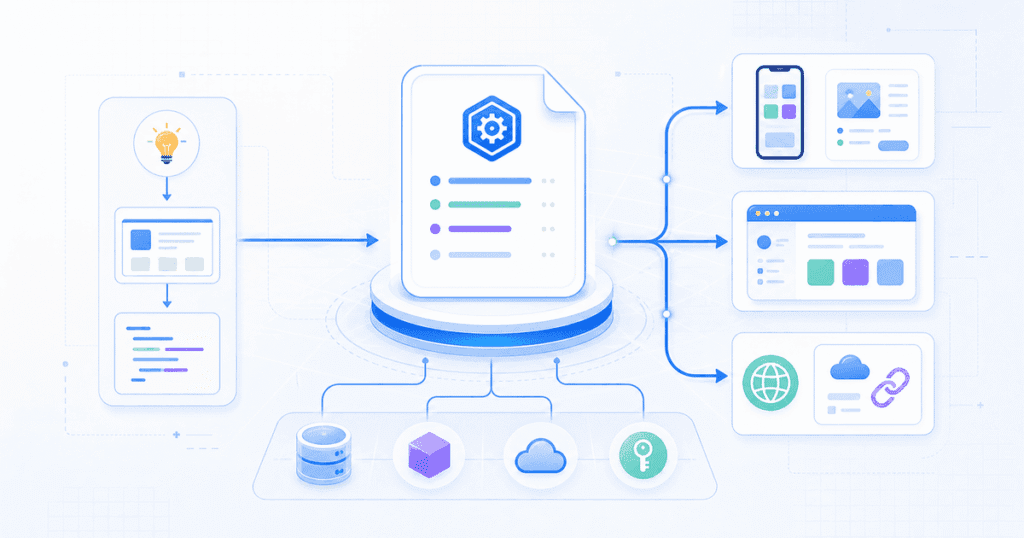
API-first software architecture India SaaS companies increasingly adopt means the API contract — its requests, responses, and error formats — gets designed and reviewed before any UI or backend code exists, so every client, whether web, mobile, or a partner integration, builds against one stable, versioned foundation instead of a screen-specific shape.
This matters because Indian SaaS companies increasingly sell into markets where customers expect integrations — Slack, Salesforce, Tally, payment gateways — on day one, not as a roadmap item. If you want the deeper context on when a structural change like this is worth it versus a full rebuild, see our breakdown on refactoring versus rebuilding software in India.
By Anand Nair · Last updated: July 16, 2026
Key Takeaways
API-first software architecture India teams adopt means the API contract is designed and reviewed before any UI or backend code is written.
An OpenAPI specification written upfront lets frontend, mobile, and backend teams build in parallel instead of waiting on each other.
Versioning, idempotency, and consistent error responses are the three design principles that keep an API-first system stable as it grows.
Monoliths can adopt an API layer incrementally through the strangler pattern, without a full rewrite.
Skipping contract review before coding is the single most common mistake teams make when going API-first.
What API-First Actually Means
API-first means the API is the first artifact your team designs, reviewed and agreed on before a single UI screen or backend function exists. In a traditional build, developers code the database, then the backend logic, then bolt on endpoints to serve whatever the frontend ends up needing. That ordering works fine for a single web app with no other consumers.
However, the moment a second consumer shows up — a mobile app, a partner integration, an internal admin tool — UI-first teams discover their endpoints are shaped around one screen’s needs, not a general contract. API-first flips this: the contract is the product, and the UI, mobile app, and any partner integration are all just clients of that same contract. As a result, every consumer gets the same data shape and the same guarantees from day one.
Why Indian SaaS Companies Are Adopting It
The core benefit is parallel development: once the contract is locked, frontend and backend engineers build against it simultaneously instead of the frontend team waiting for backend endpoints to exist. This alone compresses delivery timelines significantly on multi-platform products. In addition, because the contract is explicit and versioned, adding a new integration — a CRM, a payment processor, a partner’s system — means writing a client against documented endpoints instead of reverse-engineering undocumented internal routes.
Mobile and web parity is the other major driver. When both clients consume the identical API, feature gaps between the mobile app and the web app stop happening by default, because there’s only one backend contract to satisfy, not two diverging implementations. This is why most Indian product companies selling B2B SaaS — where customers demand integrations during procurement, not after — now default to API-first for any new platform.
How to Document an API Before Writing a Line of Code
You document the API first using an OpenAPI specification, a machine-readable contract that defines every endpoint, request shape, response shape, and error case before implementation starts. The OpenAPI Initiative maintains this as the industry-standard format, and tooling across nearly every language can generate server stubs, client SDKs, and documentation directly from one spec file. Here is a realistic snippet for a SaaS invoicing endpoint:
openapi: 3.0.3
info:
  title: Invoicing API
  version: 1.2.0
paths:
  /v1/invoices/{invoiceId}:
    get:
      summary: Retrieve an invoice by ID
      parameters:
        - name: invoiceId
          in: path
          required: true
          schema:
            type: string
      responses:
        '200':
          description: Invoice found
          content:
            application/json:
              schema:
                type: object
                properties:
                  id: { type: string }
                  status: { type: string, enum: [draft, sent, paid, overdue] }
                  amountDue: { type: number }
        '404':
          description: Invoice not found
          content:
            application/json:
              schema:
                type: object
                properties:
                  error: { type: string }
                  code: { type: string }
Once this spec is reviewed and approved, it becomes the single source of truth. Backend engineers implement against it, frontend and mobile engineers mock against it, and QA writes contract tests against it — all before a feature is “done” in the traditional sense.
📊 Key Stat: Postman’s 2024 State of the API Report found that 74% of developers say API-first development speeds up their build process, with API-related work consuming an average of over 29 hours per developer per week — underscoring why getting the contract right early pays off across the entire build cycle.
Design Principles That Keep an API-First System Stable
Three principles decide whether an API-first system stays maintainable as it grows: versioning, idempotency, and consistent error responses. Skip any one of these, and the API becomes fragile the moment a second consumer depends on it.
Versioning prevents breaking changes from reaching live clients. Put the version in the URL path (/v1/, /v2/) or in a header, and never change an existing version’s response shape — ship a new version instead. This means an old mobile app version in the field keeps working even after the backend evolves.
Idempotency keeps retried requests safe. A client retrying a failed payment request because of a network timeout should never trigger a second charge. Accepting an Idempotency-Key header on write operations, as Stripe’s API does, guarantees the same key always produces the same result, no matter how many times the client retries.
Consistent error responses reduce integration friction. Every endpoint should return errors in the same shape — a machine-readable code field plus a human-readable message — so client code can handle failures generically instead of parsing a different error format per endpoint.
💡 Pro Tip: Define your error response schema in the OpenAPI spec itself, in the same review cycle as the success responses — teams that leave error shapes “for later” end up with five inconsistent formats across twenty endpoints within two quarters.
Migration Path: Adding an API Layer to a Monolith Without a Rewrite
You add an API layer to an existing monolith using the strangler pattern: build new endpoints as a thin API layer in front of the monolith, route new traffic through it, and migrate old routes gradually. You do not need to rewrite the monolith to go API-first. Instead, you wrap it.
Start by placing a reverse proxy or API gateway in front of the monolith. Define OpenAPI contracts for the three or four highest-value endpoints — usually the ones a new mobile app or partner integration needs first — and implement those as new, clean endpoints that call into existing monolith logic internally. Therefore, the monolith’s business logic stays untouched while its interface gets modernized one endpoint at a time.
Over time, you keep extending this pattern: each new feature gets built API-first, while legacy screens keep working exactly as before until there’s a business reason to migrate them. This avoids the all-or-nothing risk of a full rewrite, which is why the strangler pattern remains the dominant migration strategy for monolith-to-API transitions.
Common Mistakes
Skipping Contract Review Before Coding
Teams that treat the OpenAPI spec as documentation written after the code, rather than a contract reviewed before it, lose the entire benefit of parallel development. The spec has to be the thing frontend and backend teams argue about and agree on first — not a record of what backend engineers happened to build.
Versioning Too Late
Some teams ship a “v1” API without ever planning for v2, then discover a breaking change is unavoidable once external partners depend on the contract. Decide your versioning scheme — URL path versioning is the simplest — before the first external consumer connects, not after.
Letting the UI Dictate the Data Shape
If the API’s response fields exist purely to match one screen’s layout, every new client has to either accept an awkward shape or request a new endpoint. Design the contract around the underlying resource — an invoice, a user, an order — not around any single screen.
Proof: A Real Monolith-to-API Migration
Quinoid’s engineering team applied this exact strangler-pattern migration on a fintech client’s five-year-old PHP monolith that needed a new mobile app and a partner integration delivered within a single fiscal quarter. Rather than rewrite the monolith, Quinoid’s engineers defined OpenAPI contracts for twelve core endpoints — account balance, transaction history, KYC status, and payment initiation — and built them as a thin API layer routed through a gateway sitting in front of the existing codebase. The mobile app and the partner integration were then built against those same twelve endpoints in parallel, cutting integration time from an estimated ten weeks of sequential handoffs down to four weeks of concurrent development. Eighteen months later, that same contract has absorbed two additional partner integrations without a single breaking change, because every new client simply consumed the existing, versioned specification.
FAQ
How much does it cost to move to an API-first architecture in India?
Cost depends on how many existing endpoints need wrapping and how many consumers the new contract must serve, but most Indian mid-market SaaS teams budget for a focused engagement covering contract design, gateway setup, and the first wave of migrated endpoints rather than a full system rebuild.
How long does an API-first migration take?
A strangler-pattern migration for a handful of high-value endpoints typically takes four to eight weeks, because you are wrapping existing logic rather than rewriting it. A full monolith decomposition into many services takes considerably longer and should be scoped separately.
What are the alternatives to going fully API-first?
Some teams adopt a hybrid approach: keep the existing UI-first monolith for internal screens, but require every new external-facing feature to ship with an OpenAPI contract first. This captures most of the integration benefit without a wholesale architectural change.
Do we need microservices to be API-first?
No. API-first describes how you design the contract, not how many services sit behind it. A single well-documented monolith with a clean API layer is API-first; a poorly documented set of microservices is not.
Which tools help enforce API-first practices?
OpenAPI-compatible tools like Swagger Editor, Redoc, and contract-testing frameworks such as Dredd or Pact let teams validate that the implementation matches the spec automatically, catching drift before it reaches production.
Conclusion
API-first software architecture India SaaS companies adopt comes down to one sequencing change: design the contract before the code, and every consumer — web, mobile, or partner — builds against the same stable foundation. Whether you’re starting a new platform or wrapping a legacy monolith with the strangler pattern, the principles stay the same: version early, design for idempotency, and keep error responses consistent.
If your team is planning this transition and wants engineering support that has done it on production fintech systems, explore Quinoid’s backend development and product engineering practice or read more on choosing the right tech stack for an India-based SaaS startup.
Put these ideas into practice
Discuss how this applies to your business.
Bring your question or current challenge. We can help clarify the next step.