

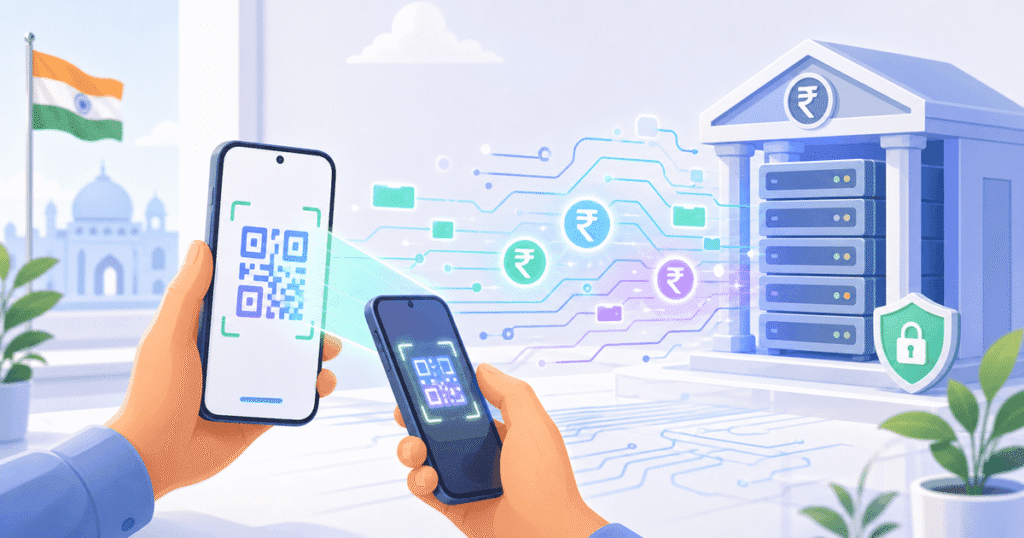
Updated July 27, 2026. NPCI’s May 2026 volume and safer AutoPay guidance replaced older figures and blanket thresholds.
A solid UPI integration developer guide India teams can actually follow comes down to four decisions: pick a PSP-backed gateway instead of raw NPCI integration, choose Collect or Pay flows based on who initiates the transaction, build idempotent webhook handling from day one, and scope your PCI DSS surface before you write a line of payment code. Get those four right and the rest of the build is mostly configuration.
Most engineering teams underestimate UPI integration because the checkout UI looks trivial — a VPA field and a QR code. The hard part is everything behind it: signature verification, retry storms from PSP apps, reconciliation when a webhook never arrives, and now, autopay mandates that follow RBI’s additional-factor-authentication rules. We have shipped UPI flows across fintech and D2C platforms at Quinoid, including the payment infrastructure we built for Upfin, and the failure patterns repeat across almost every client.
If you are still comparing the broader checkout stack before committing engineering time to UPI specifically, our guide to choosing the right development partner covers how to evaluate that decision first.
By Anand Nair · Last updated: September 6, 2026
Key Takeaways
UPI integration developer guide India teams need in 2026 starts with choosing a PSP-backed gateway over direct NPCI onboarding, which cuts compliance overhead dramatically.
Collect flow suits low-value, customer-initiated payments; Pay flow suits checkout where the merchant needs immediate, deterministic confirmation.
Webhook idempotency, not the payment API call itself, is the single biggest source of production bugs in UPI integrations.
RBI’s additional-factor-authentication mandate for UPI Autopay changed how subscription products must structure mandate creation and renewal flows.
Gateways that are PCI DSS certified reduce your own compliance scope to tokenized references only, never raw payment credentials.
The UPI Ecosystem: NPCI, PSP Apps, VPA, and UPI 2.0 Mandates
NPCI (National Payments Corporation of India) operates the UPI rails, but your product never talks to NPCI directly — you integrate through a bank or a PSP-backed gateway that already holds NPCI certification. Every transaction routes through a Virtual Payment Address (VPA), the alias like name@bank that hides the underlying account number. This separation is why UPI feels instant to users but still has layered settlement happening underneath.
UPI 2.0 added mandates, overdraft accounts, and invoice-in-the-loop payments, and these are the building blocks behind UPI Autopay and recurring billing. According to NPCI’s own product overview, UPI now processes over 23 billion transactions a month — a scale that explains why PSP apps like Google Pay, PhonePe, and Paytm enforce strict timeout and retry behavior on your integration. If your backend cannot handle a retried request safely, you will see duplicate charges at this volume.
Integration Options: Razorpay, Cashfree, PhonePe for Business, and Paytm PG
Each major gateway gives you UPI access, but they differ in settlement speed, autopay support, and developer experience. Razorpay’s UPI APIs are the most documented and support Collect, Intent, and QR flows with a unified webhook schema, which is why most of our clients default to it for new builds. Cashfree, on the other hand, often wins on settlement T+1 speed and has strong autopay mandate APIs that we have used for subscription products.
PhonePe for Business is worth considering if a large share of your traffic already happens on the PhonePe app, since it can route those transactions natively. Paytm PG remains relevant for merchants with existing Paytm wallet relationships, but its documentation lags behind Razorpay and Cashfree, so plan extra integration time. Because gateway choice affects your entire payment architecture, this decision should happen before any other technical work — including the UI.
| Gateway | Best for | Autopay support | Settlement |
|---|---|---|---|
| Razorpay | General checkout, documentation quality | Yes | T+2 (T+1 on request) |
| Cashfree | Subscriptions, fast settlement | Yes, strong mandate APIs | T+1 |
| PhonePe for Business | PhonePe-heavy user base | Limited | T+1 |
| Paytm PG | Existing Paytm wallet merchants | Yes | T+2 |
Collect vs Pay Flow: When to Use Each
Use Collect flow when the customer should approve the request from their own UPI app, and use Pay flow (intent or QR) when your checkout needs an immediate, deterministic response. Collect sends a payment request to the customer’s VPA, and they approve it inside their PSP app — this works well for invoicing or low-pressure use cases, but it can take minutes if the customer doesn’t act immediately. Pay flow, by contrast, opens the customer’s UPI app directly from your checkout (via intent on mobile or QR on web), so confirmation typically lands within seconds.
For e-commerce checkout specifically, Pay flow is almost always the right call because cart abandonment rises sharply with any delay. We default every e-commerce development engagement to intent-based Pay flow on mobile web, falling back to QR only on desktop where no UPI app is installed locally.
💡 Pro Tip: Never default to Collect flow for checkout. It feels simpler to implement, but the multi-minute approval window kills conversion on anything time-sensitive.
Webhooks, Idempotency, and Reconciliation: The Parts That Bite You Later
Webhook idempotency is the single most under-engineered part of UPI integrations, because it only fails under retry storms and edge-case timing — not in your first round of testing. Gateways retry webhooks if your endpoint doesn’t return a 200 fast enough, and PSP apps themselves retry the underlying transaction if the user double-taps. Without an idempotency key check, both situations create duplicate order confirmations or, worse, duplicate fulfillment.
The fix is straightforward: store every processed webhook’s unique transaction reference before you act on it, and reject anything you have already seen. This needs to happen atomically, ideally as a database constraint rather than an application-level check.
// Express webhook handler with signature verification + idempotency
const crypto = require('crypto');

app.post('/webhooks/upi', async (req, res) => {
  const signature = req.headers['x-razorpay-signature'];
  const expected = crypto
    .createHmac('sha256', process.env.WEBHOOK_SECRET)
    .update(JSON.stringify(req.body))
    .digest('hex');

  if (signature !== expected) {
    return res.status(400).send('Invalid signature');
  }

  const { payment_id, event } = req.body.payload.payment.entity;

  // Idempotency check — unique constraint on payment_id in DB
  const alreadyProcessed = await db.query(
    'SELECT 1 FROM webhook_events WHERE payment_id = $1',
    [payment_id]
  );
  if (alreadyProcessed.rowCount > 0) {
    return res.status(200).send('Already processed');
  }

  await db.query(
    'INSERT INTO webhook_events (payment_id, event, received_at) VALUES ($1, $2, now())',
    [payment_id, event]
  );

  // Safe to fulfill order here
  res.status(200).send('OK');
});
Reconciliation is the second half of this problem. Webhooks occasionally never arrive — a PSP outage, a network blip on the gateway’s end — so you also need a scheduled job that polls the gateway’s transaction status API for any order still “pending” after a few minutes. Relying on webhooks alone, with no fallback poll, is how teams end up with orders stuck in limbo that customer support has to fix manually.
UPI Autopay for Subscriptions: What Changed and What It Means for Your Product
UPI AutoPay authentication and transaction limits depend on the mandate type, amount, merchant category, issuing bank, and current RBI/NPCI rules. Product teams should not hard-code one universal ₹15,000 threshold; use the gateway’s current mandate APIs and test category-specific behavior. This RBI-driven change closed a gap where recurring payments could be set up with a single approval and then debited indefinitely without further checks.
In practice, this means your product needs a clear mandate-creation screen showing amount, frequency, and validity, plus a notification flow before each debit — most gateways now push this notification automatically. If your subscription product was built before these rules tightened, audit your mandate flow now, because non-compliant mandates get silently rejected by banks rather than failing with a clear error.
📊 Key Stat: UPI processed 23.20 billion transactions in May 2026, according to NPCI’s official data — a volume that makes idempotent webhook handling non-negotiable for any product at scale.
Security: 2FA, Dispute Handling, and PCI DSS Scope
The biggest security win in UPI integration is that you almost never touch raw payment credentials, because the PSP app handles authentication entirely outside your system. Your backend only ever sees a VPA reference and a transaction ID, which keeps your PCI DSS scope minimal compared to card payments. This is one of the most practical reasons fintech teams prefer UPI-first checkout for new products.
Dispute handling still needs explicit engineering, though. Build a reconciliation dashboard that surfaces every transaction’s gateway status next to your internal order status, because support teams cannot resolve a chargeback or failed-debit complaint without that view. We built exactly this kind of dashboard for fintech software development clients who needed audit-ready transaction logs for RBI compliance reviews.
UPI Payment Gateway Integration Requirements Checklist
UPI payment gateway integration requirements in India extend beyond displaying a QR code or opening an intent URL. Before development begins, product, engineering, finance, security, and operations teams should agree on the gateway account, supported payment flows, reconciliation owner, refund process, webhook security, failure states, and production-support responsibilities.
Business and Gateway Readiness
- Complete merchant onboarding, KYC, bank-account verification, and gateway activation.
- Confirm supported UPI flows, transaction limits, settlement cycle, refund process, disputes, and commercial fees.
- Decide whether the product needs one-time payments, QR, intent, subscriptions, or mandates.
- Define order expiry, payment timeout, duplicate-payment handling, and customer-support messages.
- Assign an owner for daily settlement and reconciliation exceptions.
Engineering Requirements
- Create server-side orders and keep gateway secrets outside browser or mobile code.
- Verify request and webhook signatures using the gateway’s current documentation.
- Use a unique idempotency key for every logical payment or refund operation.
- Treat the verified server-to-server result as authoritative; never trust a client success screen alone.
- Store gateway payment, order, refund, settlement, and internal transaction identifiers separately.
- Handle pending, success, failure, expiry, reversal, and late webhook states explicitly.
- Use bounded retries and make webhook processing safe when the same event arrives more than once.
- Build a reconciliation job that compares internal records with gateway reports or APIs.
Security and Production Operations
- Use HTTPS, restricted credentials, secret rotation, and environment separation.
- Redact credentials and unnecessary personal data from application logs.
- Alert on signature failures, unusual retry volume, reconciliation differences, and settlement delays.
- Test app-switch cancellation, slow networks, duplicate callbacks, delayed webhooks, refunds, and gateway outages.
- Document incident ownership and a safe way to disable a broken payment path.
- Review the gateway’s current compliance and integration requirements before every material flow change.
| State | Customer experience | Backend action |
|---|---|---|
| Pending | Show processing; do not promise fulfilment | Wait for verified status or reconcile |
| Success | Confirm order once | Apply an idempotent fulfilment transition |
| Failed/expired | Offer a safe retry | Close the attempt without reusing its identity |
| Late success | Explain that payment was received | Reconcile and fulfil or refund by policy |
| Refund pending | Show expected processing state | Track gateway status until final |
Common Mistakes Teams Make Integrating UPI
Treating Webhook Delivery as Guaranteed
Many teams write fulfillment logic that only triggers on a successful webhook call, with no fallback. When a webhook is delayed or dropped, the order sits in a pending state forever. Always pair webhooks with a polling fallback for orders that stay unconfirmed past a short timeout window.
Skipping Idempotency Keys on Retry-Prone Endpoints
This is the most common bug we see in code review. A double-tap on “Pay” or a retried webhook without a unique-reference check creates a duplicate charge or duplicate order. As a result, support tickets spike right after a high-traffic sale event, exactly when the team has the least time to debug it.
Hardcoding Gateway-Specific Response Formats
Teams that integrate directly against one gateway’s webhook schema often discover, months later, that switching providers means rewriting the entire payment module. Building a thin internal abstraction layer over the gateway response — even a simple normalizer function — avoids this lock-in.
What This Looks Like in Production
On the Upfin platform, we integrated Razorpay’s UPI Collect and Pay flows alongside Cashfree’s autopay mandates for a hybrid lending-and-subscription product. The idempotency layer above — built on a Postgres unique constraint plus a five-minute reconciliation poll — eliminated duplicate-charge tickets entirely after launch, down from roughly a dozen per month during the pilot phase. That single change had more measurable impact on support load than any UI improvement we made that quarter.
Settlement reconciliation against Cashfree’s T+1 reports also caught three mismatched transactions in the first month, all traced to webhook retries that arrived out of order. Therefore, build your reconciliation job to be idempotent too — it should never assume webhooks arrive in the sequence they were sent.
Frequently Asked Questions
How much does UPI integration cost for a typical product?
Gateway fees for UPI transactions in India are typically near-zero or capped well below card processing rates, though engineering cost for a production-ready integration — including webhooks, reconciliation, and autopay — usually runs four to eight weeks of dedicated developer time.
How long does a UPI integration take to go live?
A basic Collect/Pay checkout integration can go live in one to two weeks using Razorpay or Cashfree’s SDKs. Adding autopay mandates, reconciliation jobs, and dispute-handling dashboards extends that to six to eight weeks for most teams.
What are the alternatives to UPI for digital payments in India?
Cards, net banking, and wallets remain available through the same gateways, but UPI typically has the highest conversion rate at checkout in India because of near-universal adoption and zero added cost to the customer.
Do I need separate PCI DSS certification if I only accept UPI?
No. Because UPI authentication happens inside the PSP app rather than on your servers, your PCI DSS scope stays minimal as long as you never store or transmit raw payment credentials — the gateway’s certification covers the rest.
Can I switch UPI gateways later without rebuilding checkout?
Yes, if you build a normalization layer over the gateway’s webhook and response formats from the start. Without that layer, switching gateways usually means rewriting the payment module rather than swapping a configuration value.
Conclusion
A working UPI integration developer guide India teams can rely on always comes back to the same four pillars: the right gateway, the right flow for your use case, bulletproof idempotency, and a security model that keeps your compliance scope small. Skip any one of these and the gaps surface in production, usually during a high-traffic sale when you have the least time to fix them.
If your team is scoping a fintech or e-commerce build that needs this kind of payment infrastructure done right the first time, Quinoid’s product development team has shipped exactly this across multiple live platforms.
Put these ideas into practice
Discuss your next store improvement.
Share the customer journey or operational problem you want to solve.